Every leader has experienced the “boardroom nod.”
You project a bold new strategic initiative on the screen, for instance, “becoming customer-centric”. One by one, every executive around the table agrees. You leave the room feeling a surge of confidence, believing your team is fully aligned. Yet weeks later, execution stalls and behaviour drifts: the CFO is still aggressively cutting costs, the COO is prioritising rigid operational consistency, and the marketing director is chasing wild, bespoke innovations. The unified strategy lies in pieces, leaving you to wonder: How did we fall apart so quickly when everyone said yes?
The answer is that what looked like alignment was actually organisational theatre. In the high-stakes environment of leadership, we constantly mistake superficial agreement (Decision Alignment) for deep, operational alignment. We treat the unanimous approval of a slide deck as a victory, completely blind to the silent, competing undeclared values driving individual behaviours under the hood.
To bridge this “hidden gap,” we must understand the social psychology of false agreement, unpack the three distinct levels of alignment, and rewrite the leadership playbook to test for truth rather than comfort.
I. The Psychological Theatre of False Agreement
Why do highly intelligent executive teams consistently fall into the trap of false agreement? While traditional business literature often lumps collective dysfunction under the generic banner of “groupthink,” social psychology and values-based diagnostics reveal that false agreement is driven by three distinct mechanisms. In my book, The Hidden Gap, I explore how systemic forces like the Abilene Paradox lock teams into compliance. Here, we must go one story deeper into the social cognitive biases that trigger that silence in the first place, specifically, the False Consensus Effect and Asch Conformity.
While the psychology explains the behaviours we see, analysing a team's underlying operating values explains what individuals are actually protecting when they choose these behaviours.
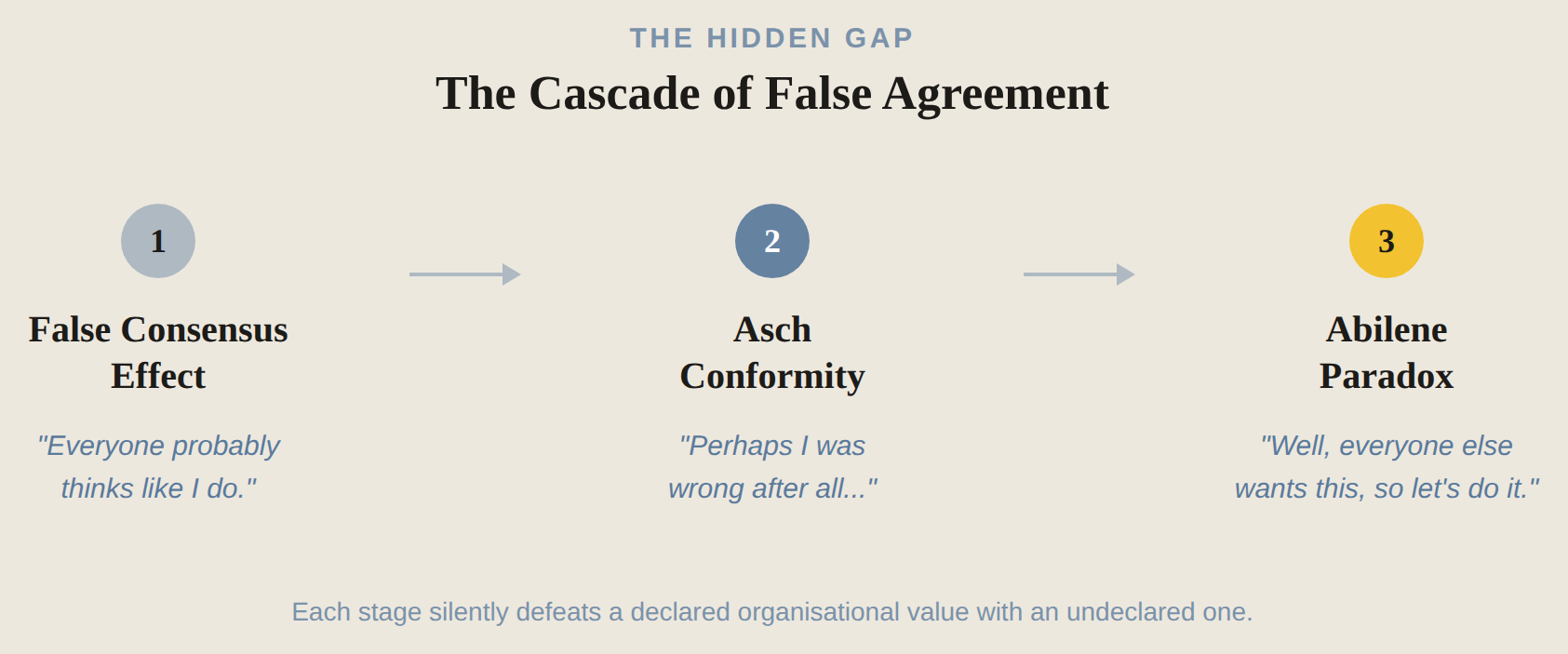
1. The False Consensus Effect
- The Internal Voice: “Everyone probably thinks like I do.”
- The Mechanism: This is an individual cognitive bias driven by projection rather than social pressure. Leaders naturally overestimate how many of their peers share their specific beliefs, values, or behaviours. For example, a leader might confidently assert, “Most managers would fire an employee who did that,” assuming their personal worldview is the universal standard, when in reality, perhaps only 20% would agree.
- The Winning Undeclared Value: We project our views onto others because it psychologically validates our own identity. In the internal competition of values, the undeclared value of Certainty silently defeats the declared organisational value of Curiosity.
2. Solomon Asch's Conformity (The Line Experiment)
- The Internal Voice: “I don't want to stand out.”
- The Mechanism: In Solomon Asch's classic experiments, participants conformed to a group's obviously incorrect answer about line lengths simply to avoid looking stupid or standing out. Here, the individual privately knows the group is wrong, but publicly complies anyway. It is pure compliance, not belief, the very definition of corporate theatre.
- The Winning Undeclared Value: Executives choose compliance because, in a low-safety or highly hierarchical culture, the undeclared value of Belonging defeats the declared organisational value of Honesty.
3. The Abilene Paradox
- The Internal Voice: “Nobody else wants what I want, so I'll just go along with it.”
- The Mechanism: This is the most subtle and damaging trap: a state of pluralistic ignorance where a team collectively agrees to a decision that literally not a single person privately wants. For example, an entire board might sign off on a £3 million digital transformation project because the CFO thinks the CEO wants it, while the CEO privately opposes it but believes the board is pushing for it. The company drives full-speed towards a destination nobody desired.
- The Winning Undeclared Value: The engine of this paradox is the protection of peace. The undeclared value of Harmony defeats the declared organisational value of Challenge.
The Cascade of Organisational Decay
In many organisations, these three traps operate as a sequential progression of decay:
- It begins with False Consensus, where a few dominant voices assume their worldview is the default.
- This triggers Asch Conformity, as doubting team members look around, misinterpret the apparent unanimity, and stay silent to avoid standing out.
- The silence is misread as enthusiastic support, locking the team into the Abilene Paradox, committing to a path that absolutely nobody actually supports.
II. Beyond the HBR View: The Three Stories of Alignment
Most conversations about organisational values stop at the level of the slide deck. The words on the wall, not the behaviour in the room.
Contemporary management frameworks (such as Harvard Business Review's “The False Alignment Trap”) do an excellent job of describing the symptoms of false alignment. HBR notes that teams fail when they mistake superficial agreement for alignment on why they are changing, what success looks like, and how they will execute. This superficiality leads to classic operational symptoms:
- Paralysis: Endless discussions and debates with zero concrete decisions.
- Hyperactivity: A flurry of uncoordinated actions that yield little actual progress.
- Tunnel Vision: Rapid, efficient execution, but in the completely wrong direction.
However, while HBR successfully diagnoses the symptoms, it treats false alignment, and the strategy execution failures that follow it, primarily as a procedural issue. It assumes that better, more disciplined conversations and formal sign-offs will solve the problem.
While describing these symptoms is valuable, solving them requires diagnostic precision. This is where the core of my book's framework, The Hidden Gap, provides a deeper, explanatory layer: a three-storey hierarchy of alignment. You cannot resolve a strategic conflict until you know which storey of the house your leaders are actually arguing in.
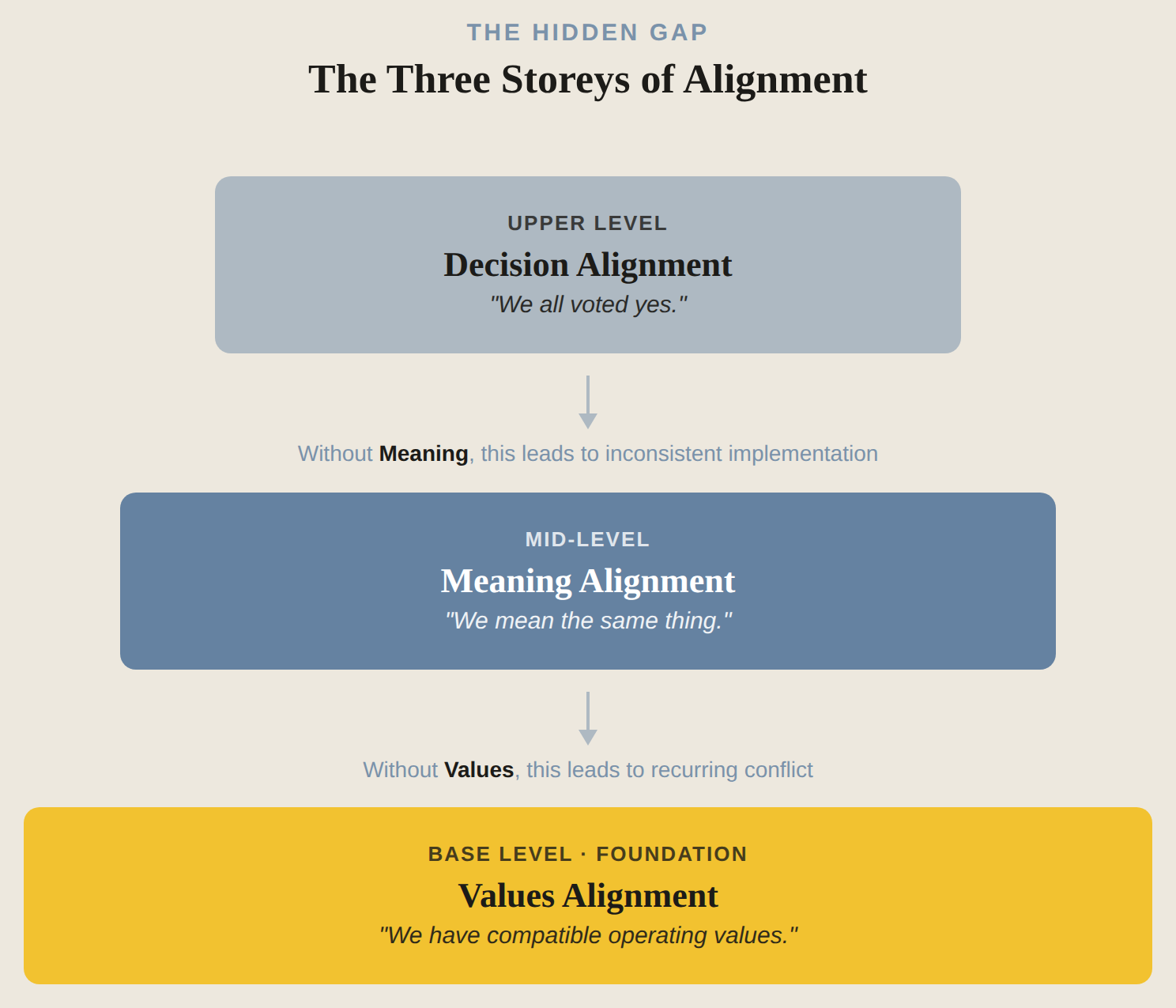
Upper Level: Decision Alignment (“We all voted yes.”)
The surface layer is Decision Alignment. This is the classic boardroom vote or project sign-off. It is necessary but purely procedural.
Mid-Level: Meaning Alignment (“We mean the same thing.”)
One story down is Meaning Alignment. It means sharing a precise, operational definition of terms.
The Failure Mode: Decision alignment without meaning alignment leads to inconsistent implementation. If a team agrees to “prioritise the customer” without defining what that means in practice, every department will execute their own conflicting interpretations of that goal.
Base Level: Values Alignment (“Our operating values are compatible.”)
At the foundation is Values Alignment. It means that the fundamental, unconscious reasons driving our support for a decision are compatible. This is the base level. Everything above it is caused from here.
Consider the “customer-centric” initiative again. The executive team achieves Upper Level Decision Alignment, and they might even agree on a dictionary definition (Mid-Level Meaning Alignment). But look at their hidden values:
- CEO: Driven by Growth
- CFO: Driven by Predictability or Risk Reduction
- COO: Driven by Efficiency or Consistency
- HR Director: Driven by Inclusion or Belonging
- Marketing Director: Driven by Innovation
They all sincerely support the sentence, but nobody agrees on the values driving it.
The Failure Mode: Meaning alignment without values alignment leads to recurring conflict as soon as trade-offs appear. The moment the team must choose between an expensive, highly customised customer solution (Growth/Innovation) or a standardised, low-cost operational process (Efficiency/Predictability), the superficial alignment shatters.
The magic of Values Alignment is that it does not require instant agreement on every choice; rather, it makes disagreement highly productive because leaders understand why they differ at the root.
III. Rewriting the Leadership Playbook: From Theatre to Truth
To transform alignment from a theatrical ritual into a powerful operational diagnostic, leaders must integrate disciplined decision protocols with values-based discovery. Here is a four-step playbook to cross the hidden gap:
Step 1: Treat Quick Agreement as a Warning Sign
If your leadership team signs off on a major strategic shift in under thirty minutes, do not celebrate. Treat quick agreement as a red flag for Asch conformity or an Abilene Paradox. Force the team to slow down and actively debate meaning and trade-offs rather than rushing to a decision.
Step 2: Use Private, Safe Spaces
While public transparency is valuable, high-stakes alignment is best built in private. Encourage one-to-one, private conversations before formal board meetings. In these low-pressure, psychologically safe spaces, leaders can explore ideas, reveal uncertainty, negotiate trade-offs, and save face without the pressure of performing for a group.
Step 3: Ask “The Compromise Question”
When asking an executive team to sign off on a strategic path, banish the generic question: “Do we all agree?”. Instead, ask:
“Which of your undeclared values did you have to compromise to support this decision?”
This simple question is a powerful diagnostic. It forces leaders to map their real-time choices directly onto the Values Integrity Model (VIM), instantly revealing whether a declared strategy is operating as a core driver or merely running as expensive boardroom theatre. If you can map where these compromises sit before you leave the room, you can predict exactly where strategic drift will occur.
Step 4: Align Incentives, Not Just Slide Decks
Unified messaging is a corporate fantasy if operating values and incentives remain in conflict. People do not follow PowerPoint; they follow incentives and their operating values. If the CFO's bonus is tied to cost reduction, the COO's to predictability, and the CEO's to growth, the organisation will receive three conflicting operational messages within weeks of the “aligned” presentation. Leaders must align the structural reward systems with the values required for the strategy, or the strategy will fail.
Conclusion: Stop Rehearsing, Start Executing
True organisational alignment is not about achieving absolute harmony or eliminating dissent. It is about bringing the “hidden gap” of operating values out of the shadows and into productive debate.
The next time you gather your leadership team to roll out a strategy, stop running the script of agreement. Stop asking if they agree. Ask them what they are compromising to say yes. That is the difference between performing alignment theatre and building a team that actually executes.
References
- Harvard Business Review, “The False Alignment Trap”, July–August 2026.
- Jerry B. Harvey, “The Abilene Paradox: The Management of Agreement”, Organisational Dynamics, 1974.
- Saul McLeod, “Asch Conformity Line Experiment”, Simply Psychology.
- Mark Buchan MSc, The Hidden Gap: Solving the Human Alignment Problem, 2026.