Ask ten leaders in the same organisation whether their culture lives its values, and you'll get ten honest answers that don't agree with each other. That used to confuse me. Now it's the whole point.
Values aren't one thing happening to everyone at once. They sit in different positions for different people, often in the same room, often about the same decision. The Values Integrity Model (VIM) is how I map which position is actually in play. I built it after enough workshops where a values statement went up on a wall, everyone nodded, and the nodding told me precisely nothing about what was running the place.
VIM is the framework underneath The Hidden Gap, and underneath most of what I write here. Values Theatre, Underground Values, the whole vocabulary. So it's worth fifteen minutes to explain properly, once, so I can just point back to this page from now on.
In one sentence
the Values Integrity Model (VIM) asks whether a value has been declared and whether it's actually operating, then places it in one of five positions, Core, Underground, Theatre, Aspirational or Void, depending on the answer. I use it to work out which values are genuinely running the decisions inside an organisation, and which ones are just on the wall.
Two questions, not one
VIM asks two questions about any value. Not one.
First: is it declared? Has someone actually said it, written it down, put it on a wall or in a strategy deck?
Second: is it operating? Is it actually driving decisions right now, especially the inconvenient ones?
Most values conversations only ever ask the first question. That's most of the problem right there. A value can be declared and dead. A value can be operating hard and never once get mentioned. Put both questions on two axes, declared and operating, and you don't get a tidy line running from good culture to bad culture. You get five distinct positions.
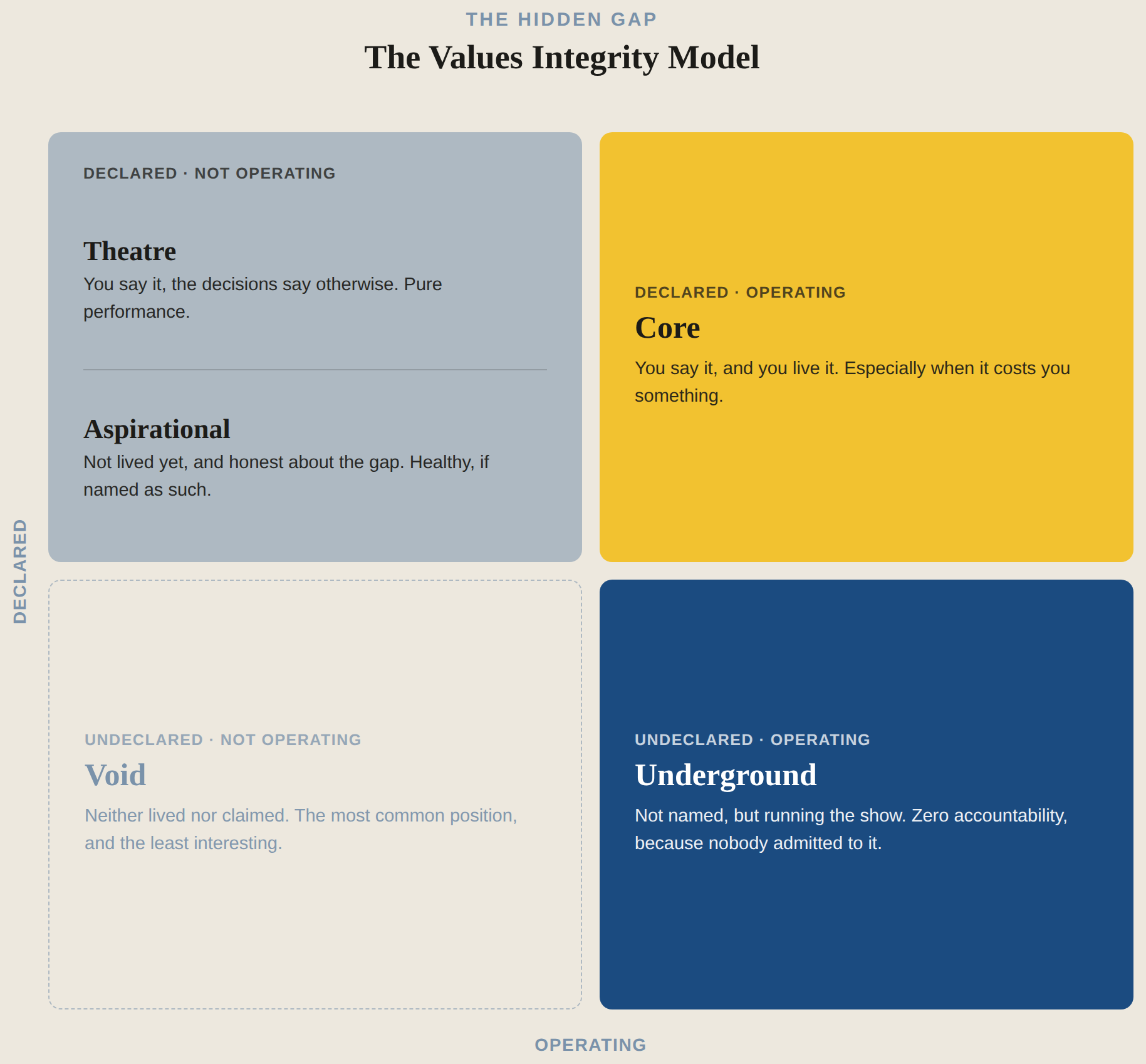
The five positions
Core. Declared and operating. This is the value someone actually lives by, especially when it costs them something. They said it, the decision got hard, and they did it anyway. Not many values earn this position, and that's fine. A value doesn't need company here. It needs to be true.
Underground. Undeclared and operating. Nobody named this value, and it's quietly running the whole show. It's the real reason the decision got made, and it shows up nowhere in the minutes. Underground values aren't automatically the villain. Speed, caution, loyalty to the founder: plenty of undeclared values are perfectly sensible. What makes them dangerous is that nobody can hold them to account, because officially they don't exist.
Theatre. Declared, not operating, and nobody's saying so out loud. This is the value on the wall that the decisions quietly contradict. You say collaboration, then promote whoever shouts loudest in the meeting. Everyone in the building can feel the gap. Nobody's allowed to name it. This is the position that does the most damage, because from a distance it looks exactly like integrity.
Aspirational. Declared, not operating, and everyone knows it. From the outside this looks identical to Theatre. The difference is honesty. An aspirational value is one you've named and haven't earned yet, and you say so. “We want to be the kind of place where junior people challenge senior people. We're not there yet.” That sentence is worth more than most mission statements, because it's true.
Void. Undeclared and not operating. Nobody's pretending, and nobody's hiding anything either. It's just not there. This is the most common position for most values in most organisations, most of the time. It's also the least interesting, which is exactly why it gets ignored in favour of arguing about the other four.
One away day, five positions
Picture a leadership team at a mid-sized firm, two years ago, at an away day. Five values go up on the wall. By the time the coffee's cold, all five are sitting in different positions, and nobody in the room has noticed.
“We move at speed” is Theatre. It's been on every deck since the away day, and the managing director still can't remember the last project she killed early, whatever the data said.
Underneath it, undeclared, is the real reason things do move fast in that building: the managing director hates losing face in front of clients. That's Underground. It works, it drives real decisions every week, and it will never appear in a values statement, because saying it out loud would be a career-limiting move.
One director on that team genuinely does kill projects the moment the numbers turn, no exceptions, no matter who's attached to them. For her, “we move at speed” is Core.
A newer director says something braver than anyone else in the room: “we're not fast yet, and I don't think we're honest about that.” That's Aspirational, and it's the healthiest sentence spoken all day.
And “sustainability”, declared at that same away day two years ago, hasn't been mentioned since. Nobody's defending it. Nobody's killing it either. It's sitting in Void, gathering dust on a slide nobody opens.
Same team, same wall, same morning. Five different positions. That's what VIM is built to see.
Why this matters more than it looks like it should
None of these five positions are fixed. A value can move between them, quarter to quarter, decision to decision. That's the point of naming them. Not to sort your organisation into a box, but to give you a precise question to ask instead of the useless one everyone defaults to.
Stop asking “do we live our values?” Nobody can answer that honestly, because it isn't really a question. Ask instead: which position is this value actually in right now, and who benefits from it staying there?
The gap does not close because people try harder. It closes because they see more clearly.
If you want to see VIM working on a real leadership team, The Illusion of Agreement walks through what happens when a team believes it's aligned and isn't.
If you want to find out which of these five positions your own organisation is actually standing in, The Hidden Gap Diagnostic is built to find out.
VIM is the framework at the centre of my book, The Hidden Gap: Solving the Human Alignment Problem. Published June 19th 2026 by The Human Alignment Company.